

Side Strain in Cricket: Why Fast Bowlers Are at Risk and How to Get Back to Bowling Safely
By Kunjal Shah Gada (M.P.Th Sports) | Physiocure – The Sports Rehab Clinic, Santacruz West, Mumbai
If you’ve ever felt a sudden, sharp pain in your side while bowling, as if something tore just below your ribs, you may have had a side strain. It is one of the most common and frustrating injuries in cricket.
What is a side strain?
A side strain is a tear or overstretch of the muscles along the side of your trunk, mainly the internal and external oblique muscles. These muscles run between your ribs and your pelvis. They help you twist, bend sideways, and keep your body stable.

Typical signs include:
- Sudden pain in the side of the trunk, usually around the lower ribs
- Pain that gets worse when you twist, bend, cough, or sneeze
- Swelling or bruising in the area after a few days
- Tightness or discomfort while bowling that gradually gets worse
Side strains also occur in other sports with powerful twisting movements, such as baseball, rowing, and ice hockey. In cricket, they are especially common in fast bowlers.
What the research found
A cross-sectional study published in the Research Journal of Medical Sciences (2025) surveyed 278 male bowlers at cricket grounds in Peshawar. The main findings:
- About 3 in 4 bowlers (74.8%) reported a side strain injury.
- Fast bowlers made up the largest group (63.7%) and were the most affected.
- Faster bowling speeds were linked with more injuries.
- Poor fitness was strongly linked with injury. Bowlers rated as having poor fitness had the most injuries, while those rated excellent had none.
- Bowlers reporting moderate to severe pain were also more likely to have a side strain.
The researchers concluded that lower fitness, faster speeds, and a history of pain go hand in hand with side strain.
Although side strain is a recognised injury among cricket fast bowlers, its incidence in female cricketers remains poorly documented. Most available epidemiological research on women’s cricket identifies injuries involving the thigh, lower back, shoulder, knee and wrist. More specific injury surveillance is required to establish the prevalence of side strain among female fast bowlers.
Why does it happen? The biomechanics of a Side strain Injury.
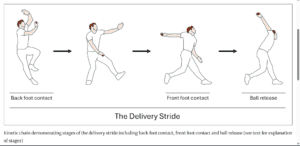
Think of fast bowling as a whip. Your body builds up energy, then releases it through your arm. Here’s how your trunk is involved:
- The run-up and jump. You build momentum and load your body.
- Front foot landing. Your front leg braces and stops your lower body, but your upper body is still travelling forward and rotating.
- The twist and side-bend. To whip the arm through, your trunk rotates and bends sideways. The side opposite your bowling arm is stretched out and has to work very hard to control this movement.
- The follow-through. The muscles must slow everything down safely.
Side strains usually happen on the side opposite your bowling arm. That side is stretched and contracting hard at the same moment, which is very demanding on muscle fibres. The faster you bowl, the greater the forces. Repeat this over and over with tired or underprepared muscles, and a tear becomes much more likely.
That is why fitness and speed matter so much in the study. A strong, well-conditioned trunk can absorb these forces. A tired or weak one cannot.
Does Bowling Technique Influence the Risk of Side Strain?
Although bowling technique influences trunk muscle activation and loading patterns, current evidence does not establish that front-on or side-on bowlers are more susceptible to side strain.
From a clinical assessment perspective, I would investigate:
-
Trunk rotation and lateral flexion during the delivery stride.
-
Internal and external oblique strength and endurance.
-
Non-bowling arm pull-down mechanics.
-
Thoracic rotation and mobility.
-
Hip–shoulder separation and coordination.
-
Bowling workload and recovery between sessions.
These are assessment considerations, not all proven independent risk factors.
How we treat it: a sports physiotherapy approach
At Physiocure, we treat side strain in stages. The exact plan depends on how severe the injury is and what your bowling demands are.
1. Assessment
We find out what was injured, how badly, and why it happened. This includes checking your trunk movement, strength, flexibility, pain levels, and bowling action. If needed, we may recommend imaging such as an ultrasound or MRI to confirm the extent of the tear.
2. Early recovery
Relative rest from bowling, pain management, and gentle movement within comfortable limits. Complete inactivity is not the goal, because controlled movement helps healing. Hands-on manual therapy can help relieve pain and improve mobility.
3. Rebuilding strength and control
As pain settles, we progress to:
- Core and trunk strengthening, including the obliques and deep stabilizing muscles
- Hip and shoulder strength, since the whole body shares the load
- Flexibility and side-bend mobility work
- Rotational and side-bending exercises that mimic bowling
4. Cricket-specific rehab and return to bowling
Our rehab moves from general exercises to movements specific to your sport. We bring you back gradually: throwing, then short run-ups, then more balls and more speed. Rushing this stage is the most common reason for re-injury.
5. Prevention
- A structured strength and conditioning program, including our physio-guided fitness sessions
- Workload management, avoiding sudden jumps in overs or training sessions
- Proper warm-ups and recovery
- A review of bowling technique when needed
- Taking early pain seriously instead of bowling through it
The return-to-bowling programme should progressively increase:
-
Bowling intensity.
-
Number of deliveries.
-
Run-up length.
-
Number of spells.
-
Match-specific demands.
Avoid increasing bowling volume and intensity simultaneously. Monitor symptoms during training and the following day.
Coaches and academies can also ask about our injury prevention workshops, which teach sport-specific techniques and exercises to reduce injury risk.
Don’t bowl through the pain
One finding from the study stands out: bowlers with higher pain levels were more likely to have a side strain. If you have persistent pain in your side, get it checked early. A mild strain that is ignored can become a bigger tear and keep you out for much longer.
When can a fast bowler start bowling again?
A useful clinical guide from A Clinician’s Guide to Side Strains in Cricket Fast Bowlers suggests that a bowler should demonstrate:
-
No pain during breathing, coughing or sneezing.
-
Full, pain-free trunk range of motion.
-
Pain-free lateral flexion towards the injured side.
-
Good strength without pain during progressive muscle contraction testing.
A note on the study
This study was cross-sectional and included only male bowlers from one city, so it shows associations, not proven cause and effect. Still, its findings fit what other cricket research has reported: fitness, workload, and bowling intensity matter.
An important clinical caution: Pain around the lower ribs should not automatically be labelled a side strain. Rib stress injury, rib avulsion and other chest-wall conditions need to be considered, particularly if symptoms are severe or persistent.
Book an assessment
Whether you’re a young fast bowler, a club player, or returning from injury, we can help you recover and bowl with confidence.
Physiocure – The Sports Rehab Clinic
📍 F/16, Bussa Apartment, V.M. Bhargav Road, Santacruz (W), Mumbai (Landmark: Near Khira Industrial Estate)
📞 +91 98330 72272
✉️ info@physiocure.in
🕘 Monday to Saturday: 10.00 AM–3 PM and 4 PM–8 PM
🌐 Book an appointment
This article is for general education and does not replace personal medical advice. If you suspect an injury, please consult a qualified healthcare professional.
Reference:
- Rehman S.U., Aziz M., Malik U., Waqar S., Jan H., Ullah I. (2025). Prevalence and Associated Risk Factors of Side Strain Injuries in Professional Cricket Bowlers. Res. J. Med. Sci., 19(5): 16-20. doi: 10.36478/makrjms.2025.5.16.20
- https://pmc.ncbi.nlm.nih.gov/articles/PMC5958448
- https://www.sportsinjurybulletin.com/improve/a-clinicians-guide-to-side-strains-in-cricket-fast-bowlers

